Introduction
Preparing for a surgical technology certification exam requires more than memorizing medical terminology. Candidates need to understand sterile technique, surgical instruments, anatomy, operating room procedures, patient safety, and the responsibilities of the surgical technologist throughout a procedure. They must also be able to apply that knowledge to practical situations, recognize potential breaks in sterile technique, and make appropriate decisions within the scope of their role.
For candidates pursuing the National Center for Competency Testing (NCCT) Tech in Surgery–Certified (TS-C) credential, structured preparation can help organize these subjects into a manageable study plan. Rather than studying isolated facts without context, learners benefit from connecting technical knowledge to the workflow of an operating room and the safety principles that guide surgical care.
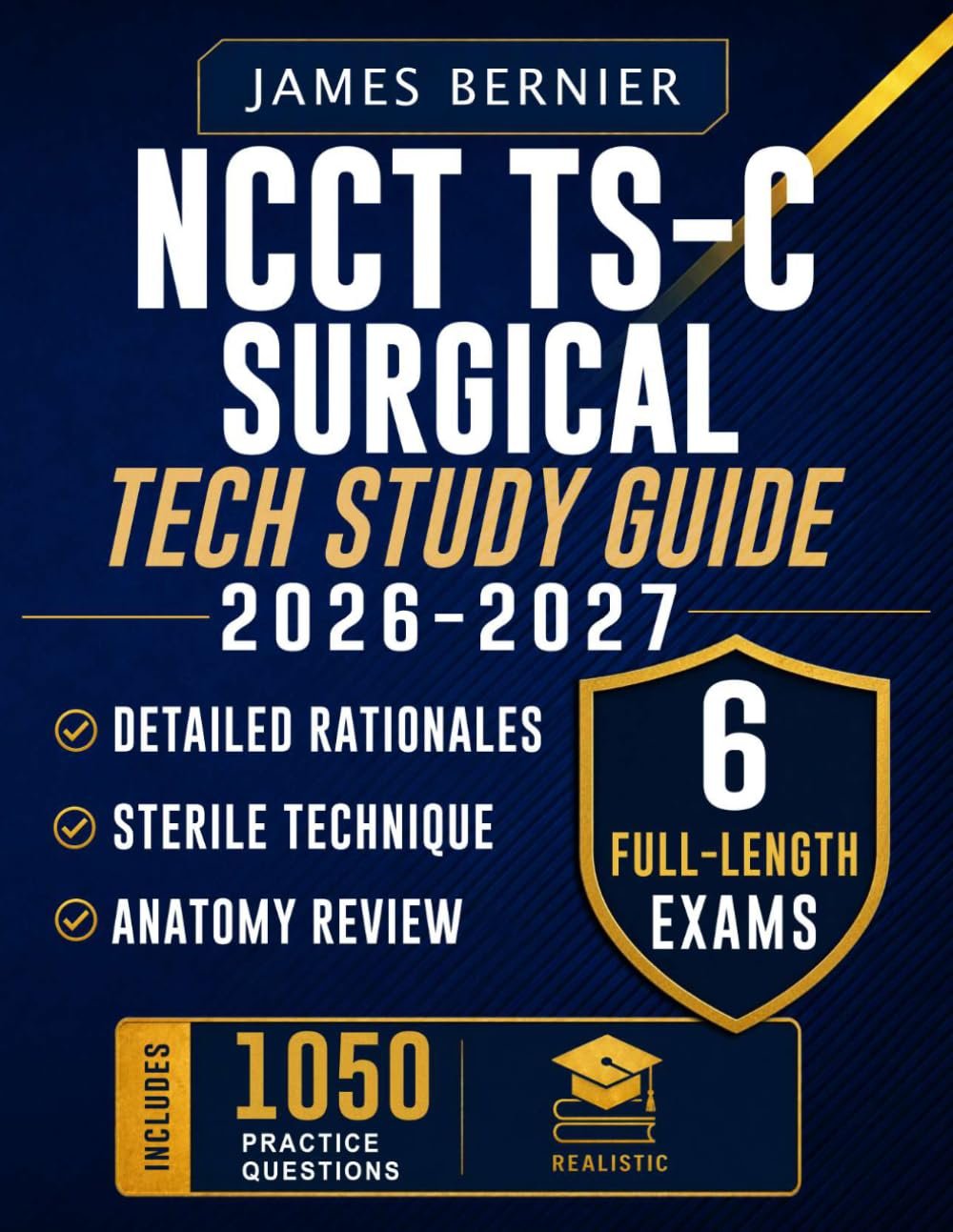
The NCCT TS-C Surgical Tech Study Guide 2026–2027 is presented as an exam-preparation resource covering six full-length practice exams, 1,050 practice questions, detailed rationales, sterile technique, surgical workflow, and anatomy review. These elements address several important areas of preparation: reviewing foundational concepts, testing knowledge under exam-like conditions, and understanding why a particular answer is appropriate.
A study guide can be a useful part of a certification plan, but it should not be treated as a guarantee of passing or as a substitute for formal surgical technology education, clinical experience, or current official examination information. Candidates should verify eligibility requirements, the current examination outline, and any applicable testing policies directly with NCCT.
This article explores the purpose of the study guide, the educational value of its advertised features, practical ways to use practice questions and full-length exams, and the factors candidates should consider when preparing for the TS-C examination.
Understanding the NCCT TS-C Certification
The TS-C credential is associated with the National Center for Competency Testing, an organization that offers certification examinations for several healthcare occupations. The Tech in Surgery–Certified credential relates to the knowledge and professional responsibilities expected of surgical technologists.
Surgical technologists work as part of a perioperative healthcare team. Their responsibilities can include preparing the operating room, organizing instruments and supplies, maintaining sterile technique, assisting with the preparation of the sterile field, and supporting the surgical team according to their training, assigned duties, facility procedures, and applicable regulations.
The role requires technical knowledge as well as attention to detail. A surgical technologist must understand why instruments are handled in particular ways, how contamination can occur, and why communication and established procedures matter during surgery.
Certification preparation therefore needs to cover more than definitions. It should help candidates understand the relationships between anatomy, surgical procedures, instrumentation, infection prevention, and patient safety.
Why Structured Exam Preparation Matters
A certification examination can include material that candidates have studied at different times during their education. Without a plan, it is easy to spend too much time on familiar topics while neglecting weaker areas.
A structured study guide can help create a consistent routine. Candidates can divide the material into subjects, answer questions, review explanations, and revisit concepts that repeatedly cause difficulty.
Practice questions also encourage active recall. Instead of simply rereading notes, learners must retrieve information and apply it to a question. This process can reveal misunderstandings that passive reading might not expose.
However, practice materials should be used alongside the current official exam outline. The fact that a topic appears in a commercial study resource does not establish how frequently it appears on the actual examination or whether every question accurately reflects the current test format.
Key Features of the NCCT TS-C Surgical Tech Study Guide 2026–2027
The product title identifies several features intended to support exam preparation. Each serves a different purpose, and the value of the resource depends on how candidates use those features in a broader study routine.
1. Six Full-Length Practice Exams
Full-length practice examinations can help candidates assess their readiness across multiple subject areas. Unlike a short quiz on a single topic, a complete practice test requires learners to work through a broader selection of questions while maintaining concentration.
Taking a full-length test can reveal whether a candidate understands material across the curriculum or performs well only in familiar subjects. It can also help identify problems with pacing, fatigue, or the tendency to spend too much time on difficult questions.
Repeated practice may allow learners to compare their results over time. For example, a candidate might complete an initial test, review the incorrect answers, study the relevant subjects, and then take another practice exam to evaluate progress.
The advertised six exams provide a potential framework for this process. Still, candidates should confirm the format, question distribution, timing recommendations, and answer explanations provided in the current edition.
Practice-test performance is an indicator of preparation, not a prediction that guarantees the same result on the official examination.
2. A Collection of 1,050 Practice Questions
The guide advertises 1,050 practice questions, offering candidates a substantial collection of material to work through.
A large question bank can help learners encounter different ways of testing the same concept. For example, sterile technique may be assessed through terminology, recognition of contamination risks, or a scenario involving the handling of a sterile instrument.
Variety matters because knowing a definition is not always the same as applying it correctly. A candidate may understand the meaning of a sterile field but still need practice recognizing situations that could compromise it.
The number of questions alone, however, does not determine educational quality. Clear wording, accurate answers, relevant explanations, and alignment with current exam objectives are also important.
Candidates should avoid treating question completion as the primary measure of progress. Answering hundreds of questions without reviewing mistakes can reinforce misunderstandings rather than correct them.
A more effective approach is to use each question as an opportunity to identify what is known, what remains uncertain, and what needs further study.
3. Detailed Rationales for Answers
The product title highlights detailed rationales, an important feature of educational question banks.
A rationale explains why an answer is correct and may clarify why other options are less appropriate. This allows learners to examine the underlying principle rather than simply memorizing a letter or phrase.
Suppose a practice question concerns a possible break in sterile technique. Memorizing the correct option may help with a similar question, but understanding the rationale is more useful because it explains the safety principle behind the decision.
Rationales can also reveal gaps in basic knowledge. A candidate who repeatedly selects an incorrect option may misunderstand a term, confuse two instruments, or apply a general rule to the wrong situation.
When studying, learners should summarize the principle behind each mistake in their own words. This encourages understanding and makes later revision more efficient.
If a rationale appears inconsistent with current professional guidance, candidates should verify the issue using authoritative educational materials, current facility procedures where applicable, and recognized standards. Commercial study resources should not be treated as the sole authority for clinical practice.
4. Sterile Technique Review
Sterile technique is central to surgical technology because contamination can create risks for patients and compromise the surgical field.
A useful review should cover the purpose of sterile practice, the distinction between sterile and nonsterile areas, the handling of sterile instruments and supplies, and the recognition of situations that may compromise sterility.
Candidates also need to understand that sterile technique is not merely a list of rules to memorize. It depends on attention, observation, communication, and consistent adherence to established procedures.
For example, a learner may be asked to identify an issue involving a damaged package, an item with uncertain sterility, or an accidental contact between sterile and nonsterile surfaces. The important task is to recognize the underlying contamination risk and understand that the response must follow established clinical procedures.
A study guide can reinforce these principles, but it should not replace supervised laboratory instruction or clinical training. Real operating room decisions must follow applicable policies, professional guidance, and the direction of the responsible surgical team.
5. Surgical Workflow and Operating Room Procedures
Surgical workflow refers to the sequence of activities and coordinated responsibilities involved in preparing for and supporting a surgical procedure.
For a surgical technologist, understanding workflow can help connect individual tasks to the wider purpose of safe perioperative care. Preparation may involve arranging instruments and supplies, checking required materials, maintaining the sterile field, and coordinating with other members of the team.
During a procedure, the technologist must remain attentive to the surgeon’s needs, the organization of instruments, the condition of the sterile field, and applicable counting and documentation processes.
After the procedure, responsibilities may include handling instruments and materials according to facility protocols, supporting room turnover, and following procedures for appropriate cleaning, decontamination, and transport.
The precise division of duties varies by facility, training, jurisdiction, and assigned role. Candidates should study the responsibilities described in their formal education and the current exam outline rather than assuming every workplace follows an identical workflow.
6. Anatomy Review
Anatomy knowledge helps surgical technologists understand the structures involved in surgical procedures and communicate accurately with the healthcare team.
A strong review should connect anatomical terms with their locations, functions, relationships, and relevance to common surgical approaches. Candidates may need to distinguish structures that are close together, understand directional terminology, and recognize the basic organization of body systems.
Anatomy also supports understanding of surgical instruments and procedural sequences. When learners understand the region involved in a procedure, the purpose of particular instruments or supplies may become easier to understand.
Studying anatomy only through isolated definitions can make recall difficult. Diagrams, labeling exercises, comparison tables, and short self-tests can help learners build a more organized mental picture.
The study guide’s advertised anatomy review may provide a starting point, but candidates should use additional course materials when a topic requires more detailed explanation or visual instruction.
How the Study Guide Can Be Used
The value of an exam-preparation resource depends on the study method used. The following approaches can help candidates turn practice questions and exams into a structured learning process.
Step 1: Begin With the Official Exam Outline
Before completing large numbers of questions, obtain the current TS-C examination information from NCCT.
The official outline helps establish which subject areas candidates are expected to understand and may identify the relative emphasis placed on different domains. It also provides a reference for checking whether a commercial resource covers the relevant objectives.
Create a checklist based on the official outline. Then compare it with the topics included in the study guide.
This step prevents candidates from assuming that the contents of a commercial book perfectly match every current examination requirement.
Step 2: Assess Your Starting Knowledge
Begin with a diagnostic quiz or a practice test, depending on the resource’s structure and the amount of time available.
The purpose of an initial assessment is not to achieve a perfect score. It is to discover which topics are familiar and which require more attention.
Record the results by subject whenever the materials make that possible. A candidate may perform well in anatomy but struggle with sterile technique, or understand instrumentation while needing more practice with workflow-related scenarios.
Use the results to establish priorities rather than studying every subject for exactly the same amount of time.
Step 3: Divide Topics Into Manageable Sessions
A large study resource can feel overwhelming when treated as one continuous assignment. Breaking the material into smaller sessions makes it easier to maintain consistency.
For example, a weekly schedule might include anatomy review on one day, instrumentation on another, and sterile technique on a separate day. Later sessions can focus on surgical workflow, safety concepts, and mixed practice questions.
The exact schedule should reflect the candidate’s current knowledge, available study time, and examination date.
Short, focused sessions are often more practical than occasional marathon sessions, particularly when learners are balancing employment, family responsibilities, or clinical training.
Step 4: Use Practice Questions Actively
When answering a question, try to identify the principle being tested before looking at the explanation.
If the question describes a scenario, identify the relevant facts, the safety concern, and the role of the surgical technologist. Then select the answer that best fits the stated conditions.
After checking the answer, review the rationale even when the response was correct. A correct guess does not necessarily indicate a solid understanding of the concept.
If the answer was incorrect, write down the reason. This might involve confusing terminology, overlooking a key detail, misunderstanding an instrument’s purpose, or recalling a rule inaccurately.
Step 5: Maintain an Error Log
An error log is a simple record of questions answered incorrectly or concepts that remain uncertain.
For each entry, note the subject, the nature of the misunderstanding, and the correct principle. Keep the explanation concise enough to review quickly.
For example:
- Topic: Sterile technique.
- Issue: Confusing an item that appears clean with an item confirmed to be sterile.
- Review goal: Understand the conditions required for sterile status and the procedures used when sterility is uncertain.
The example illustrates a study method rather than a clinical instruction for a particular situation. Actual practice must follow current protocols.
Review the error log regularly. Repeated mistakes often reveal a broader gap in understanding that can be addressed more effectively through focused study than by answering additional random questions.
Step 6: Review Anatomy Visually
Anatomy is easier to organize when learners combine terminology with spatial understanding.
Use diagrams, labeled illustrations, and blank diagrams that can be completed from memory. Try to explain the location and function of a structure without looking at the answer.
It may also help to connect anatomical regions with the general types of procedures that involve them. The objective is to understand the relationships between structures, not merely memorize disconnected lists.
When a diagram or explanation in a study resource is unclear, consult trusted course textbooks or educational materials.
Step 7: Use Full-Length Exams Strategically
The advertised six full-length practice exams can potentially be distributed across the preparation period rather than completed all at once.
One approach is to use an early test to identify weaknesses, several later tests to assess progress, and a final test to practice sustained concentration before the examination.
When completing a practice exam, follow the timing instructions supplied with the material. Work in a quiet environment and avoid checking answers before finishing the test.
Afterward, spend sufficient time reviewing mistakes. The learning that follows an exam can be more valuable than the score itself.
Step 8: Revisit Difficult Topics
Repeated exposure can help strengthen recall, especially when practice is spaced over time.
Instead of reviewing a topic only once, return to it after a short interval and test yourself again. Continue revisiting the concepts that remain difficult.
For example, a candidate who struggles with instrument identification can use short recall sessions, visual comparisons, and targeted questions until the distinctions become clearer.
The goal is not simply to recognize the answer when it appears on a page. It is to retrieve the information independently and apply it to a new question.
Step 9: Prepare for the Final Study Period
In the final days before the examination, prioritize review and consolidation rather than trying to learn every subject from the beginning.
Revisit the official outline, error log, essential terminology, and topics that have repeatedly caused difficulty. A shorter mixed quiz can help maintain recall without creating unnecessary fatigue.
Follow the official testing instructions and confirm any practical requirements, such as identification, scheduling, or permitted materials, directly with the testing organization.
Adequate rest and a realistic schedule can also support concentration. Studying continuously without breaks may reduce the quality of learning rather than improve it.
Who May Find This Study Guide Suitable?
The NCCT TS-C Surgical Tech Study Guide 2026–2027 may be relevant to several groups of learners, although its suitability depends on their education, certification pathway, and preparation needs.
Surgical Technology Students
Students enrolled in surgical technology education may use a certification-oriented study guide to reinforce classroom learning.
Practice questions can help identify concepts that need additional attention, while rationales may provide another way to understand terminology and safety principles.
The guide should complement formal coursework, laboratory exercises, and supervised clinical education. It should not replace required instruction or practical competency assessments.
Candidates Preparing for the TS-C Examination
Candidates who are already familiar with the foundational material may use full-length practice exams to assess their readiness.
A structured question bank can help them identify weak areas, revisit important concepts, and practice applying knowledge under timed conditions.
Before relying on the guide as a primary resource, candidates should verify that the edition aligns with the current NCCT examination outline and eligibility requirements.
Graduates Returning to Study
Some candidates may have completed their training earlier and need to refresh material before sitting for an examination.
A study guide can help organize revision across anatomy, sterile technique, instrumentation, and workflow. The error-log method can be especially useful for distinguishing remembered concepts from areas that need to be relearned.
Candidates returning after a long gap should allow time to consult foundational textbooks and current educational materials where necessary.
Learners Who Prefer Practice-Based Revision
Some people learn more effectively when they alternate reading with testing. For these learners, a resource containing a substantial question bank and full-length exams may provide a useful structure.
The key is to combine testing with explanation and review. A high volume of questions is less useful if the learner moves immediately to the next item without understanding previous mistakes.
Candidates Who Need a Study Schedule
A resource organized around multiple practice exams can help learners divide preparation into stages.
For example, a candidate might begin with a diagnostic assessment, move through targeted subject review, complete additional practice exams, and reserve the final period for correcting persistent weaknesses.
The study schedule should remain flexible. A learner who needs more time with anatomy or sterile technique should not move forward simply because a calendar says that a particular topic should already be complete.
Important Things to Consider Before Using the Guide
1. Confirm Current NCCT Requirements
Certification requirements, examination information, and administrative policies can change. Candidates should consult NCCT directly for the latest information about eligibility, examination content, registration, and testing procedures.
Do not assume that a book labeled for 2026–2027 automatically reflects every current administrative requirement or future examination change.
2. Practice Questions May Differ From the Official Exam
Commercial practice questions are educational tools. Their wording, difficulty, structure, and subject distribution may differ from those of the official examination.
Use them to reinforce knowledge and practice reasoning, not to predict the exact questions that will appear on test day.
Avoid memorizing answer patterns without understanding the underlying material. A new question may describe the same principle in a different context.
3. Verify Clinical Information
Surgical technology involves patient safety, infection prevention, instrument handling, and coordinated clinical procedures.
If a study explanation conflicts with current course materials, established professional guidance, or applicable facility procedures, investigate the discrepancy rather than assuming the commercial answer is correct.
Clinical decisions must be based on current standards, appropriate training, and the instructions of the responsible healthcare team.
4. Do Not Confuse Exam Readiness With Clinical Competence
Passing a certification examination and performing effectively in a clinical environment are related but distinct achievements.
An examination can assess knowledge and reasoning, while clinical work also requires practical skills, communication, attention to changing conditions, and the ability to follow procedures in real time.
A study guide cannot independently provide supervised practice, hands-on instrument experience, or assessment of practical competency.
5. Check the Scope of the Anatomy Review
Anatomy is a broad subject. The amount of detail needed depends on the examination objectives and the learner’s existing education.
A concise review can help reinforce essential terms and relationships, but it may not replace a comprehensive anatomy textbook or visual learning resources for complex regions.
Candidates should use their error logs and the official exam outline to decide where additional study is necessary.
6. Consider the Quality of Explanations
Detailed rationales are valuable only when they are accurate, clear, and relevant.
When reviewing an explanation, ask whether it clarifies the underlying concept and distinguishes the correct response from the alternatives. If it merely repeats the answer, additional study may be needed.
A useful learning process connects each explanation to a broader principle that can be applied to other questions.
7. Avoid Relying Only on Multiple-Choice Questions
Multiple-choice questions can support recall and reasoning, but they do not cover every aspect of learning.
Candidates should also practice explaining concepts in their own words, identifying structures on diagrams, distinguishing instruments, and describing the purpose of important workflow steps.
This variety can reveal whether the learner understands the material or simply recognizes familiar wording.
8. Set Realistic Expectations
No study guide can guarantee a passing result. Performance depends on prior education, study consistency, understanding of the examination content, test-taking skills, and other individual factors.
The most useful goal is measurable progress: fewer repeated errors, stronger recall, better understanding of difficult topics, and more consistent performance across practice tests.
Comparing General Categories of Surgical Technology Study Resources
Different educational resources support different stages of preparation. The NCCT TS-C study guide can be considered alongside several broader categories.
Comprehensive Textbooks
Textbooks provide detailed explanations, diagrams, terminology, and foundational information. They are particularly useful when a candidate needs to learn a topic from the beginning or understand a complex concept in depth.
Their length can make them less convenient for rapid revision, especially close to the examination date. A focused study guide may be easier to use for targeted practice, while a textbook provides additional detail when a concept remains unclear.
Practice Question Banks
Question banks focus on testing knowledge through short exercises, scenario-based questions, and explanations.
They are useful for active recall and identifying weaknesses. Their limitations depend on the accuracy, quality, and alignment of the questions.
A question bank should be used with authoritative learning materials rather than as the sole source of clinical information.
Full-Length Mock Examinations
Mock examinations help learners practice concentration, pacing, and switching between different subjects within one session.
They provide a broader assessment than topic-specific quizzes, but a score alone does not explain why mistakes occurred.
The greatest educational value usually comes from analyzing the results and revisiting the underlying concepts.
Flashcards and Short Revision Notes
Flashcards can help learners memorize terminology, anatomical structures, and instrument names. Short notes can also make it easier to revisit essential principles.
These tools are convenient for frequent review, but they may provide limited context for complex scenarios. They are most useful when combined with explanations and applied practice.
Formal Courses and Clinical Education
Formal surgical technology education provides structured instruction and opportunities for supervised practical learning. Clinical education also helps students connect theoretical concepts with actual professional responsibilities.
A study guide can reinforce classroom learning and support exam preparation, but it cannot replace practical instruction or clinical supervision.
Combining Resources Effectively
A balanced preparation plan may use a study guide for structured questions and practice exams, textbooks for deeper explanations, visual resources for anatomy, and formal coursework for clinical concepts.
Candidates should prioritize resources according to the official examination outline and their individual weaknesses. Adding more study materials is not automatically helpful if the learner does not have enough time to use them effectively.
Frequently Asked Questions
What is the NCCT TS-C certification?
The TS-C credential is associated with the National Center for Competency Testing and relates to the role of a certified surgical technologist. Candidates should consult NCCT for the current eligibility criteria, examination information, and certification requirements.
What does the NCCT TS-C Surgical Tech Study Guide 2026–2027 include?
The product title advertises six full-length practice exams, 1,050 practice questions, detailed rationales, sterile technique coverage, surgical workflow material, and anatomy review. Check the current listing and edition details to confirm the contents and format.
Are the six full-length exams official NCCT examinations?
The product is described as an exam-preparation guide. Unless the publisher explicitly confirms otherwise, practice exams in a commercial study guide should be treated as independent preparation materials, not official NCCT examination papers.
Will the study guide guarantee that I pass?
No. No study resource can guarantee a passing result. The guide may support preparation, but outcomes depend on knowledge, study methods, consistency, examination readiness, and other factors.
How should I use 1,050 practice questions?
Divide questions into manageable sessions, review the rationales, record recurring mistakes, and revisit weak topics. Focus on understanding why answers are correct rather than completing the largest possible number of questions.
Why are detailed rationales important?
Rationales explain the reasoning behind an answer. They can help learners understand concepts, correct misconceptions, and apply the same principle to differently worded questions.
Should I study anatomy separately?
Yes, if anatomy is an area that requires additional attention. Use the guide’s review as one component of preparation and supplement it with diagrams, textbooks, or other trusted educational materials when needed.
Can this guide replace a surgical technology course?
No. A study guide is intended to support learning and examination preparation. It does not replace formal education, supervised laboratory work, clinical experience, or practical competency assessment.
How early should I begin preparing for the examination?
The appropriate preparation period depends on your existing knowledge, study availability, and examination date. Starting early allows time for an initial assessment, targeted study, repeated practice, and review of difficult topics. Confirm the examination schedule and requirements through NCCT.
What should I do if an answer explanation seems incorrect?
Check the relevant concept against authoritative textbooks, current professional guidance, and your formal course materials. For clinical procedures, follow applicable policies and guidance from qualified instructors or the responsible healthcare team rather than relying solely on a commercial explanation.
How can I tell whether I am making progress?
Track practice performance by subject, the number of recurring mistakes, and your ability to explain concepts without looking at the answer. More consistent performance across different practice sessions can provide useful evidence of improvement, although it does not guarantee the result of the official exam.
Conclusion
The NCCT TS-C Surgical Tech Study Guide 2026–2027 is presented as a certification-preparation resource featuring six full-length practice exams, 1,050 practice questions, detailed rationales, and coverage of sterile technique, surgical workflow, and anatomy.
These components can support a structured approach to studying. Practice questions help identify gaps in knowledge, rationales provide opportunities to understand mistakes, and full-length exams allow candidates to practice applying information across several subject areas. Anatomy and sterile technique review can also reinforce concepts that are important to surgical technology education.
The most effective use of a study guide involves more than completing questions. Candidates should begin with the current official NCCT examination outline, assess their starting knowledge, create a realistic schedule, maintain an error log, and revisit difficult subjects until the underlying principles become clearer.
It is equally important to recognize the resource’s limits. Commercial practice exams are not automatically official examination materials, and study questions cannot replace supervised clinical learning or current professional guidance. Certification preparation should reinforce, rather than substitute for, a strong educational foundation.
For candidates who want a structured way to organize their TS-C exam preparation, the guide’s advertised question bank and practice exams may be worth examining alongside authoritative study materials.
You can check more details on Amazon here
As an Amazon Associate, we earn from qualifying purchases.
Leave a Reply